Claude Fable 5 and Mythos 5 Launched

Co-founder, CEO & CTO
Overview
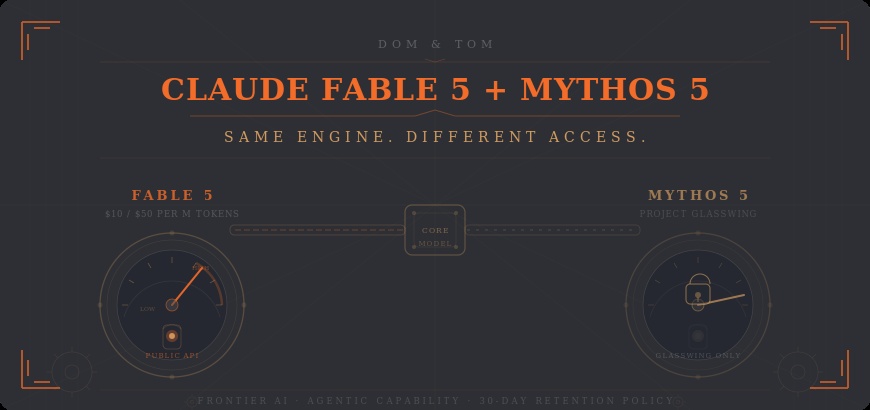
Anthropic shipped two models today: Claude Fable 5 and Claude Mythos 5. They are the same underlying model. The difference is a set of capability-restricting safeguards that Anthropic has applied to Fable 5 before making it publicly available, while Mythos 5 goes to a much smaller group of vetted organizations operating under Project Glasswing, Anthropic's controlled-access program for frontier AI.
Fable 5 is available on the API today at claude-fable-5, priced at $10 per million input tokens and $50 per million output tokens. Mythos 5 is restricted to Glasswing cyber partners for now, with a trusted biology access program opening in the coming weeks.
What does "Mythos-class" mean?
Anthropic introduced a new model tier above Opus with the release of Claude Mythos Preview in April. That model was gated entirely to cyberdefense and critical infrastructure partners through Project Glasswing. Today's announcement is the first time those capabilities have been made available to the general developer and enterprise market, albeit with guardrails.
The capability delta from Opus 4.8 to Fable 5 is significant and well-documented in the announcement.
A few data points worth highlighting:
In vision tasks, Fable 5 can now reconstruct a web application's source code from screenshots. Earlier Claude models required significant scaffolding infrastructure to complete vision-driven tasks like navigating Pokémon FireRed; Fable 5 completed the game using vision alone, with no additional harnesses.
Giving Fable 5 access to persistent file-based memory improved its performance three times more than the same setup improved Opus 4.8, and Fable 5 reached the game's final act three times more often. The significance here is the model gets meaningfully better at complex, multi-session agentic tasks when given memory tools, and the gap between Fable and Opus widens as task complexity increases.
The data retention update ot look out for:
There is a policy shift that enterprise and legal teams will ask about. Anthropic now requires 30-day data retention for all traffic on Mythos-class models, across both first- and third-party surfaces.
The stated purpose is safety: retaining data lets Anthropic detect complex jailbreaks that operate across multiple requests, and identify false positives to reduce classifier over-triggering. Anthropic states explicitly that this data will not be used for model training and will be deleted after 30 days in almost all cases. They have also implemented human access logging.
For enterprise clients with strict data handling requirements, this is worth surfacing before any procurement conversation. The retention is mandatory, the scope is model-level not org-level, and the control is Anthropic's, not the deploying organization's. That may require a review of data agreements depending on the sensitivity of the workloads involved.
.
About the author
Co-founder, CEO & CTO
Dominic Tancredi co-founded Dom & Tom in 2009 and leads engineering, AI product development, and technical strategy. He writes on building, modernizing, and operating web, mobile, and AI-powered products.
Ready to build something amazing?
Let's discuss your project and explore how we can help bring your vision to life.