Ask AI about Dom & Tom
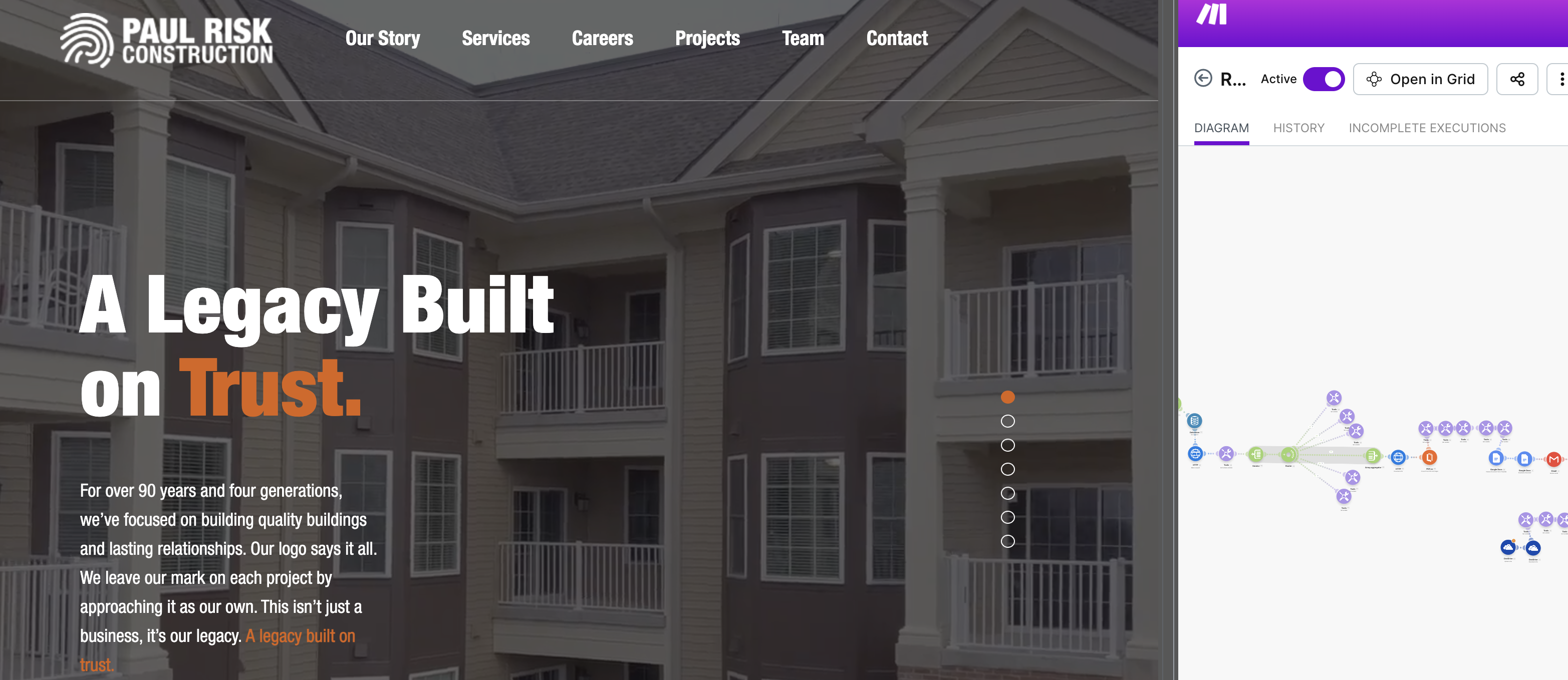
Automated Financial Workflow Integration for Paul Risk Construction
Web Development, Systems Integration, Workflow Automation, UX/UI Design
Case study summary
- Client / industry
- Automated Financial Workflow Integration for Paul Risk Construction
- Problem
- Web Development, Systems Integration, Workflow Automation, UX/UI Design
- What Dom & Tom did
- Product strategy, UX/UI, software engineering, QA, and launch support based on the documented case study scope.
- Relevant services
- Product strategyMobile app developmentWeb development
Paul Risk Construction
Automating Financial Workflows Through Intelligent Systems Integration
Dom & Tom partnered with Paul Risk Construction to eliminate manual expense documentation between Ramp corporate credit cards and HH2 accounting software, building a secure, automated workflow that improves coding accuracy, reduces administrative overhead, and accelerates month-end reconciliation.
Dom & Tom partnered with Paul Risk Construction to eliminate manual expense documentation between Ramp corporate credit cards and HH2 accounting software, building a secure, automated workflow that improves coding accuracy, reduces administrative overhead, and accelerates month-end reconciliation.
Client Overview
Paul Risk Construction
Commercial Construction · Project-Based Accounting · Financial Operations
Paul Risk Construction is a commercial contracting firm operating across multiple concurrent projects, each requiring precise job costing, GL tracking, and cost code management. With field teams making daily purchases using corporate credit cards, maintaining accurate and timely financial documentation is critical to operational success.
Commercial Construction · Project-Based Accounting · Financial Operations
Paul Risk Construction is a commercial contracting firm operating across multiple concurrent projects, each requiring precise job costing, GL tracking, and cost code management. With field teams making daily purchases using corporate credit cards, maintaining accurate and timely financial documentation is critical to operational success.
The Challenge
Each Ramp credit card transaction required multiple manual steps before reaching accounting:
• Receipt upload
• Job number assignment
• Cost code classification
• GL coding
• Manual forwarding into HH2’s invoice ingestion system
This process created friction across departments and introduced risk in the form of:
• Missed receipts
• Inconsistent formatting
• Delayed invoice entry
• Increased month-end cleanup effort
Paul Risk needed an automated bridge that could:
• Trigger upon transaction approval
• Preserve job and accounting metadata
• Generate consistent invoice documentation
• Deliver directly into HH2’s intake email
• Operate without new hosting infrastructure
• Receipt upload
• Job number assignment
• Cost code classification
• GL coding
• Manual forwarding into HH2’s invoice ingestion system
This process created friction across departments and introduced risk in the form of:
• Missed receipts
• Inconsistent formatting
• Delayed invoice entry
• Increased month-end cleanup effort
Paul Risk needed an automated bridge that could:
• Trigger upon transaction approval
• Preserve job and accounting metadata
• Generate consistent invoice documentation
• Deliver directly into HH2’s intake email
• Operate without new hosting infrastructure
The Solution
Dom & Tom designed and implemented a cloud-based automation layer connecting Ramp’s Developer API to HH2’s email-based invoice ingestion workflow.
The system automatically:
• Detects approved Ramp transactions with attached receipts
• Extracts structured metadata including Merchant, Date, Amount, Cardholder, Job #, Cost Code, and GL Code
• Generates a fixed-layout, machine-readable PDF invoice
• Appends the receipt image to the document
• Sends the completed file directly to HH2’s invoice intake address
By maintaining identical formatting across every PDF, the integration leverages HH2’s learning capabilities to improve automated coding accuracy over time.
The automation runs securely in a managed workflow environment - eliminating the need for custom hosting or infrastructure maintenance.
The system automatically:
• Detects approved Ramp transactions with attached receipts
• Extracts structured metadata including Merchant, Date, Amount, Cardholder, Job #, Cost Code, and GL Code
• Generates a fixed-layout, machine-readable PDF invoice
• Appends the receipt image to the document
• Sends the completed file directly to HH2’s invoice intake address
By maintaining identical formatting across every PDF, the integration leverages HH2’s learning capabilities to improve automated coding accuracy over time.
The automation runs securely in a managed workflow environment - eliminating the need for custom hosting or infrastructure maintenance.
Key Deliverables
• Secure OAuth-based Ramp API integration
• Approved-transaction trigger logic
• Receipt validation and filtering
• Structured metadata mapping and normalization
• Fixed-layout PDF generation optimized for machine learning ingestion
• Automated email routing to HH2
• Duplicate prevention and transaction state tracking
• Error handling and logging
The solution was built using (an efficient use of) Dom & Tom’s 5D methodology - Define, Discover, Design, Develop, Deploy - ensuring alignment between operational needs and technical execution.
• Approved-transaction trigger logic
• Receipt validation and filtering
• Structured metadata mapping and normalization
• Fixed-layout PDF generation optimized for machine learning ingestion
• Automated email routing to HH2
• Duplicate prevention and transaction state tracking
• Error handling and logging
The solution was built using (an efficient use of) Dom & Tom’s 5D methodology - Define, Discover, Design, Develop, Deploy - ensuring alignment between operational needs and technical execution.
The Impact
The integration delivered immediate operational improvements:
• Eliminated manual forwarding of receipts
• Reduced administrative burden on field and accounting teams
• Increased documentation consistency
• Improved financial coding accuracy
• Reduced month-end reconciliation effort
• Strengthened financial visibility across active projects
What once required human coordination now executes automatically upon approval.
• Eliminated manual forwarding of receipts
• Reduced administrative burden on field and accounting teams
• Increased documentation consistency
• Improved financial coding accuracy
• Reduced month-end reconciliation effort
• Strengthened financial visibility across active projects
What once required human coordination now executes automatically upon approval.
Why It Worked
This project succeeded by aligning technology with real-world financial workflows.
Dom & Tom collaborated closely with stakeholders to:
• Preserve existing Ramp coding practices
• Respect accounting intake requirements in HH2
• Design a deterministic document structure to support machine learning
• Build automation that integrates seamlessly without behavioral disruption
Rather than replacing systems, the team created a bridge between them.
Dom & Tom collaborated closely with stakeholders to:
• Preserve existing Ramp coding practices
• Respect accounting intake requirements in HH2
• Design a deterministic document structure to support machine learning
• Build automation that integrates seamlessly without behavioral disruption
Rather than replacing systems, the team created a bridge between them.
Technical Highlights
• RESTful API integration
• OAuth-secured authentication flow
• Cloud-based workflow automation
• Deterministic PDF template architecture
• Email-based system ingestion
• Scalable, extensible integration framework
• OAuth-secured authentication flow
• Cloud-based workflow automation
• Deterministic PDF template architecture
• Email-based system ingestion
• Scalable, extensible integration framework
Looking Ahead
With the automation layer in place, Paul Risk Construction is positioned to expand into:
• Vendor invoice automation
• Subcontractor documentation workflows
• Real-time financial reporting dashboards
• Expanded multi-system integrations
The modular design allows new financial automations to be layered in without rebuilding core logic.
• Vendor invoice automation
• Subcontractor documentation workflows
• Real-time financial reporting dashboards
• Expanded multi-system integrations
The modular design allows new financial automations to be layered in without rebuilding core logic.
Conclusion
The Paul Risk integration demonstrates how thoughtful digital engineering can modernize financial operations without disrupting field workflows.
By uniting API architecture, structured document automation, and user-centered systems design, Dom & Tom delivered a scalable solution that reduces friction, improves accuracy, and supports long-term operational growth.
By uniting API architecture, structured document automation, and user-centered systems design, Dom & Tom delivered a scalable solution that reduces friction, improves accuracy, and supports long-term operational growth.
Next Case Study
Continue exploring our work

Alzheimer’s Association Mobile App, “Science Hub”
Mobile Application
View Next Case Study
Ready to build something amazing?
Let's discuss your project and explore how we can help bring your vision to life.